

Periodic/Sector reports
Oil & Gas: Offshore Support Vessel Market At A New Crossroads
Highlights
- Takeaways from several OSV conferences reveal key shifts in OSV market conditions. Firstly, ageing OSV fleets are becoming a more critical issue due to a lack of incentives for newbuild orders and fleet replacement. This arises from a combination of high newbuild costs, uncertainties in the timing rollout of upstream capex, restricted OSV financing, and a capped outlook on OSV daily charter rate (DCR). However, vessel age limit is also gradually fading in relevance, with oil majors including Petronas, which prioritises conditional assessments instead.
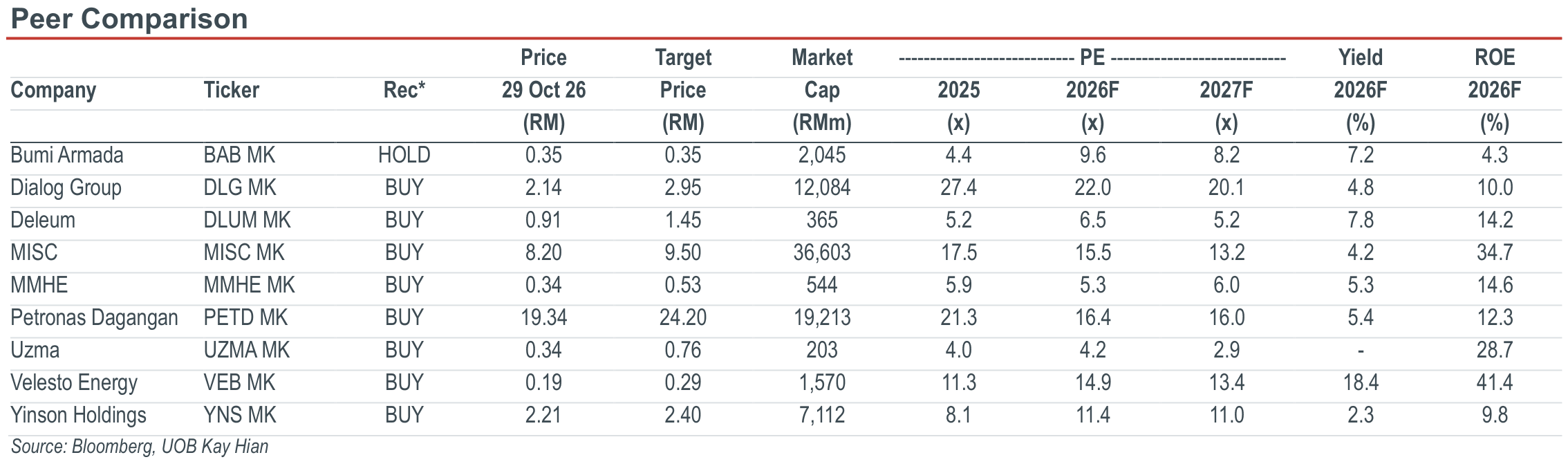
- OSV players active in adaptation may show resilience. Another shifting trend is ESG-focused, ie the increasing acceptance of alternative fuels and next generation hybrid designs over conventional models. However, the key hurdle is the capex premium. Still, OSV players should adapt to changing demand with regional collaborations and technology partners, while considering diversification to reduce reliance on OSV/O&G. We see non-rated players like Keyfield, Alam Maritim, Lianson Fleet and Perdana Petroleum as standouts. Maintain MARKET WEIGHT.
Analysis
- Ageing OSV fleet becoming more critical... According to Westwood Global Energy, the average age of the global offshore support vessel (OSV) fleet is 16 years, and based on the current orderbook, “young” OSVs (ie, OSV below 15 years of age) will comprise merely 17% of the global fleet by 2030. Platform Supply Vessel (PSV) fleet now averages 17.5 years old. For Malaysia’s OSV market, the average fleet age is around 13.2-14 years. Having said that, the newbuild numbers are unlikely to be exciting. Westwood estimates only 178 newbuilds on order (~6% of global fleet). This scarcity was a primary reason for the OSV utilisation upcycle in 2022-24, leading to daily charter rate (DCR) for anchor handling tug/supply (AHTS) and subsea vessels, and ultimately cashflow turnaround for many OSV owners.
- …but decreasing in relevance. Shipowners were faced with two options on fleet replacement. There is the option for replacement tonnage, but today’s high cost of newbuilds would imply capital costs far exceeding previous cycles. Extending the vessels’ life was the other option that gained acceptance. Life extension was a term that had until recently applied only to floating production units. Today, it is a big industry norm for OSVs. Also, charterers are setting the terms, prioritising condition and suitability over the vessel age. Petronas is one example. While it is widely known in the industry that OSVs of 20 years of age can be qualified for a Petronas charter, there is a catch. Petronas mandates OSV over 15 years to renew a condition assessment every three years with a minimum score. This condition assessment was previously more widely applied for tankers and containerships.
Highlights
- Takeaways from several OSV conferences reveal key shifts in OSV market conditions. Firstly, ageing OSV fleets are becoming a more critical issue due to a lack of incentives for newbuild orders and fleet replacement. This arises from a combination of high newbuild costs, uncertainties in the timing rollout of upstream capex, restricted OSV financing, and a capped outlook on OSV daily charter rate (DCR). However, vessel age limit is also gradually fading in relevance, with oil majors including Petronas, which prioritises conditional assessments instead.
- OSV players active in adaptation may show resilience. Another shifting trend is ESG-focused, ie the increasing acceptance of alternative fuels and next generation hybrid designs over conventional models. However, the key hurdle is the capex premium. Still, OSV players should adapt to changing demand with regional collaborations and technology partners, while considering diversification to reduce reliance on OSV/O&G. We see non-rated players like Keyfield, Alam Maritim, Lianson Fleet and Perdana Petroleum as standouts. Maintain MARKET WEIGHT.
Analysis
- Ageing OSV fleet becoming more critical... According to Westwood Global Energy, the average age of the global offshore support vessel (OSV) fleet is 16 years, and based on the current orderbook, “young” OSVs (ie, OSV below 15 years of age) will comprise merely 17% of the global fleet by 2030. Platform Supply Vessel (PSV) fleet now averages 17.5 years old. For Malaysia’s OSV market, the average fleet age is around 13.2-14 years. Having said that, the newbuild numbers are unlikely to be exciting. Westwood estimates only 178 newbuilds on order (~6% of global fleet). This scarcity was a primary reason for the OSV utilisation upcycle in 2022-24, leading to daily charter rate (DCR) for anchor handling tug/supply (AHTS) and subsea vessels, and ultimately cashflow turnaround for many OSV owners.
- …but decreasing in relevance. Shipowners were faced with two options on fleet replacement. There is the option for replacement tonnage, but today’s high cost of newbuilds would imply capital costs far exceeding previous cycles. Extending the vessels’ life was the other option that gained acceptance. Life extension was a term that had until recently applied only to floating production units. Today, it is a big industry norm for OSVs. Also, charterers are setting the terms, prioritising condition and suitability over the vessel age. Petronas is one example. While it is widely known in the industry that OSVs of 20 years of age can be qualified for a Petronas charter, there is a catch. Petronas mandates OSV over 15 years to renew a condition assessment every three years with a minimum score. This condition assessment was previously more widely applied for tankers and containerships.
IMPORTANT NOTICE - DISCLOSURES AND DISCLAIMERS
This report is provided subject to, and must be read together with, the full Disclosures / Disclaimers available at this link, which are incorporated by reference into this report. In particular, this report is intended for general circulation and informational purposes only and does not constitute personal investment advice or a recommendation to buy or sell any investment product or security. You should independently evaluate the information and, where necessary, seek advice from a qualified financial adviser regarding the suitability of any investment. Analyst certifications required under applicable regulations, including SEC Regulation AC (where relevant), are included in this report. By accessing, receiving or using this report, you acknowledge that you have read, understood and agreed to be bound by the Disclosures / Disclaimers, as may be amended, supplemented or updated from time to time.
Related articles

6 Oct 2026
Oil & Gas: Various Developments Focusing On Energy Security

3 Sept 2026
Oil & Gas: Petronas’ 1H26: Clear Legacy “Clots”; Recharge For Energy Security

16 Oct 2026
Oil & Gas: Evolution Of LNGC Supply Chain
Our latest research

20 Oct 2026
Automobile: 9M26 TIV Remains Resilient; Raising TIV Forecast To 810,000 Units
16 Oct 2026
Oil & Gas: Evolution Of LNGC Supply Chain

15 Oct 2026