

Wealth Daily
Nvidia Leads Selloff as S&P 500 Enters Correction
Today’s Must-Know News
Overnight Markets
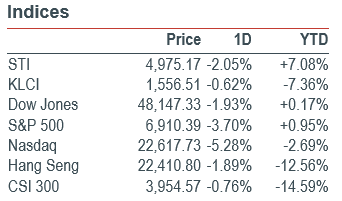
Market Movers: At the 20 November close, the S&P 500 fell 3.70% for its seventh straight loss. The Nasdaq slid 5.28%, erasing its gains for the year. Taiwan’s TAIEX had already lost 6.23%. Its regulator raised short-sale margins from 130% to 150% effective Monday. Nvidia (NVDA US) fell 14.01% to US$125.53. Reuters reported that the SEC was examining its accounting. The scope remains unclear, and shares had fallen before the report. Anthropic (ANT US) slipped 8.50% to US$88.91 in its second session, still above its US$83 offer. The IPO raised US$91.6bn for Anthropic before fees, separate from a US$26bn private placement. MiniMax (0100.HK) fell 10.80% to HK$102.40 before Hang Seng Indexes announced its inclusion in the China Enterprises Index from 7 December. (AP / Reuters / Anthropic / RTHK / Hang Seng Indexes / CNA) Nvidia (NVDA US) is our Core Recommendation.
Macro: China held its one- and five-year loan prime rates at 3.00% and 3.50%, respectively, for an eighteenth month. US consumer sentiment rose to 51.5 from 48.0. Households’ year-ahead inflation expectations fell to 3.70% from 4.70% in October. Interviews ended before Friday’s selloff, so the survey has yet to capture its effect on confidence. (ChinaMoney / Michigan)
Geopolitical: President Trump told Fox News on Sunday he was inclined to resume strikes on Iran after year-end if talks failed. The prospect leaves oil shippers facing uncertainty over access through Hormuz. (Iran International)
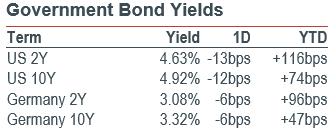
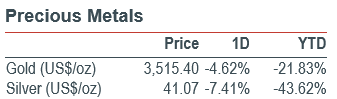
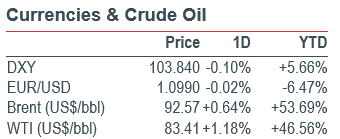
FICC: US Treasury yields fell as investors sought safety. The two-year fell 13bp to 4.63% and the ten-year 12bp to 4.92%. December gold settled 4.62% lower at US$3,515.40/oz and silver lost 7.41% to US$41.07/oz. January Brent gained 0.64% to US$92.57/bbl and January WTI rose 1.18% to US$83.41/bbl. (US Treasury / eOption / Newsquawk)
AI
Accounting inquiry adds to Nvidia’s regulatory exposure. Nvidia (NVDA US) fell 14.01% to US$125.53, extending a decline already under way when Reuters reported that US securities regulators were examining its accounting. Reuters could not establish which accounting practices were under review. The SEC declined to comment and Nvidia did not immediately respond. On Sunday, Treasury Secretary Scott Bessent said he had contacted Nvidia’s management and still wanted answers about advanced chips reaching China. The two inquiries leave investors weighing the quality of financial disclosures alongside access to overseas customers. (Reuters / CBS / US closing prices) Nvidia (NVDA US) is our Core Recommendation.
Anthropic completes its enlarged IPO as the shares retreat. Anthropic (ANT US) closed its second Nasdaq session at US$88.91, down 8.50% from its debut close but still 7.12% above the US$83 offer. Underwriters exercised the full option for 147m extra shares. The IPO raised US$93.5bn gross, including US$91.6bn for the company and the balance for selling shareholders. A separate US$26bn placement with seven technology groups closed at the same price. The deals strengthen Anthropic’s funding while tying major chip and cloud suppliers more closely to a customer. (Anthropic / Stock Analysis)
Oracle says financing is in place for its OpenAI buildout. After the US close, Oracle (ORCL US) said it had secured the capital needed for its OpenAI infrastructure contract, including vendor financing. Its Abilene site is nearly complete, and its next gigawatt-scale campus at Shackelford has received its permits. Oracle expects positive free cash flow in the second half of fiscal 2028 and targets more than US$30bn for fiscal 2029. Delivering the sites on schedule is the next test of whether the financing can translate into cash generation. (Oracle / Reuters)
A shift in Google’s chip mix could cut Broadcom orders. Broadcom (AVGO US) fell 12.19% to US$304.41 as semiconductor shares sold off. TF International Securities analyst Ming-Chi Kuo estimated that Google had reduced planned 2027 shipments of the Broadcom-designed TPU 8i by about 1m units, or roughly 20%. His supplier survey pointed to a shift towards a competing design from MediaTek. Neither Google nor Broadcom confirmed the change. The distinction matters for Broadcom because a change in the mix of chips could cost it orders even if Google maintains overall computing investment. (Stock Analysis / Investing.com / US closing prices) Broadcom (AVGO US) and Alphabet (GOOGL US) are our Core Recommendations.
Americas
Intuit’s slower sales outlook weighs on its first session after results. Intuit (INTU US) fell 12.77% to US$270.44 after revising its fiscal 2027 revenue guidance to US$23.08bn–23.37bn, or 8%–9% growth, reflecting a change in its Credit Karma forecast. First-quarter revenue increased 12% YoY to US$4.4bn, while adjusted diluted EPS rose 56% to US$2.91. Management maintained its annual earnings guidance. The gap between slower forecast sales growth and faster earnings growth makes cost control important to delivery. (Intuit / US closing prices)
Communications demand drives Keysight’s earnings growth. Keysight Technologies (KEYS US) fell 7.07% to US$261.51 in its first session after posting fourth-quarter results. Revenue reached US$1.99bn against US$1.42bn a year earlier, while adjusted EPS rose to US$3.61 from US$1.91. Communications revenue increased 51% YoY to about US$1.50bn, including 73% growth in commercial communications. Test demand was strongest in commercial networks, giving investors a clearer measure of where orders could be most exposed to a slowdown. (Keysight / US closing prices)
Ross expects holiday sales growth to slow. Ross Stores (ROST US) slipped 2.92% to US$213.46 in its first session after reporting quarterly sales of US$6.3bn, up 12% YoY. Comparable sales gained 8%, driven mainly by customer traffic, and EPS rose to US$1.91 from US$1.58 a year earlier. The off-price retailer maintained a 4%–5% comparable-sales growth target for the holiday quarter against 9% growth last year. Sustained traffic will matter more as the comparison becomes tougher. (Ross Stores / US closing prices)
Greater China
Alibaba gains as cloud growth offsets a bigger cash outflow. Alibaba (9988.HK) rose 3.48% to HK$83.35 in its first Hong Kong session after results, against a 3.78% fall in the Hang Seng TECH Index. September-quarter revenue grew 10% YoY to RMB271.5bn, while recurring cloud revenue from external customers grew 67%. The company spent more to build cloud infrastructure. Free cash outflow widened to RMB34.5bn from RMB21.8bn a year earlier. The contrast gives investors two measures to track as demand rises: recurring revenue and the cash needed to support it. (Alibaba / Hong Kong close) Alibaba (9988.HK) is our Core Recommendation.
NetEase loses almost a fifth as Hong Kong trades its results. NetEase (9999.HK) fell 17.60% to HK$154.00 in its first full Hong Kong session after reporting third-quarter earnings. Group revenue fell 1.8% YoY to RMB27.9bn. Games and related services, its largest segment, posted a 1.7% decline to RMB22.9bn. Gross profit nevertheless rose 4.8% to RMB19.0bn and operating expenses fell 5.4%. The next test of the games pipeline is Ananta, scheduled for a global launch on 15 January. (NetEase / FactSet / Hong Kong closing prices)
Kuaishou’s ad sales fall despite a larger audience. Kuaishou (1024.HK) dropped 11.37% to HK$20.42 in the first session after its results. Third-quarter revenue fell about 11% YoY to RMB31.6bn. Online marketing sales fell 11.1% to RMB17.9bn even as monthly active users grew 12% to 818.5m. The group booked a RMB959m loss against a RMB4.5bn profit a year earlier. E-commerce competition weighed on what merchants spent on the platform, limiting the earnings benefit from audience growth. (Kuaishou / Hong Kong closing prices)
MiniMax joins the China Enterprises Index after a double-digit fall. MiniMax (0100.HK) closed 10.8% lower at HK$102.40 before Hang Seng Indexes announced its quarterly review. MiniMax and Z.AI (2513.HK) will join the 50-member Hang Seng China Enterprises Index, replacing Postal Savings Bank of China (1658.HK) and Shenzhou International (2313.HK). The changes take effect on 7 December after implementation at the 4 December close. Funds tracking the index have a date for adjusting their holdings. Friday’s price fall preceded the announcement. (Hang Seng Indexes / Hong Kong closing prices)
Asia ex. China
Taiwan raises short-selling margins after the chip rout. Taiwan Semiconductor Manufacturing (2330 TT, TSM US) fell 4.76% to NT$2,000 as the Taiex lost 6.23% to 36,033.29. Odd-lot turnover in TSMC reached NT$24.12bn on Friday, the highest of any main-board company. Over the weekend the regulator raised the minimum margin for short selling to 150% from 130%, effective Monday. The change requires more collateral to maintain short exposure as the market reopens. (Taiwan closing prices / CNA trading / CNA policy) Taiwan Semiconductor Manufacturing (TSM US) is our Core Recommendation.
Samsung and SK hynix lead a broad Korean sell-off. Samsung Electronics (005930 KS) fell 7.01% to ₩183,100 and SK hynix (000660 KS) lost 5.92% to ₩1,113,000 amid concern over US chip export restrictions. The Kospi dropped 5.21% to 4,869.96. Both the main and junior exchanges briefly suspended program sell orders. Foreign investors sold a net ₩1.13tn, while individuals bought ₩1.59tn. The flow figures show domestic buyers absorbed stock as foreigners reduced exposure to the market. (Korea Exchange / Korean close) SK hynix (SKHY US) is our Investment Opportunity.
SoftBank’s AI exposure weighs on its Tokyo shares. SoftBank Group (9984 JP) fell 14.48% to ¥3,025 as technology holdings sold off across Asia. After Anthropic’s US debut, investors had a public price for one of OpenAI’s closest competitors. SoftBank said in October that its cumulative OpenAI investment had reached US$64.6bn for an approximately 13% stake after completing a US$30bn follow-on investment. The difference matters to shareholders because OpenAI is privately held and SoftBank’s stake has no daily quoted price. (SoftBank / Investing.com / Tokyo closing prices)
Japan Tobacco cuts its dividend after losing control of its Russian units. Japan Tobacco (2914 JP) fell 10.11% to ¥5,265 in the first session following its guidance cut. The company expects to recognise a ¥1.377tn loss on deconsolidating the subsidiaries. It now forecasts a ¥724bn full-year loss attributable to shareholders, against its previous ¥662bn profit forecast. The projected annual dividend falls to ¥204 per share from ¥272, including a halving of the expected year-end payment to ¥68. The dividend reduction extends the impact of the accounting charge to shareholder income. (Japan Tobacco / Tokyo closing prices)
Singapore banks fall as selling reaches almost the entire STI. The Straits Times Index lost 2.05% to 4,975.17. Of its 30 members, 26 declined and four were unchanged. DBS (D05 SP) fell 1.83% to S$66.11, while OCBC (O39 SP) lost S$0.88 to S$26.54 and UOB (U11 SP) fell S$0.72 to S$35.42. Across the exchange, decliners outnumbered gainers 493 to 163 on turnover of S$2.6bn. The breadth of the decline shows the weakness extended beyond the three banks. (The Business Times / Singapore closing prices)
EMEA and Others
ASML slide spreads the semiconductor sell-off to Europe. ASML (ASML NA) fell 9.33% to €1,168.00 in Amsterdam as investors cut exposure to suppliers of chipmaking equipment. The STOXX Europe 600 Technology sector lost 5.39%, against a 2.00% decline in the broad STOXX 600. ASM International, Infineon and STMicroelectronics also fell. Industrial suppliers linked to AI construction, including Schneider Electric and Legrand, traded lower as well. The sector moves show the reassessment reached both chip production and data-centre infrastructure. (FactSet / Amsterdam closing prices)
Middle East disruption squeezes Vallourec’s margin. Vallourec (VK FP) lost 14.57% in Paris after reporting a 10% YoY revenue decline to US$956m. Third-quarter EBITDA fell to US$181m from US$244m a year earlier, and the margin narrowed four percentage points to 18.9%. The tube maker cited additional costs in the Middle East and expects much of that cost to be reimbursed over coming quarters. Full-year EBITDA guidance of US$760m–800m leaves investors watching the timing of the recovery. (Vallourec / Paris closing prices)
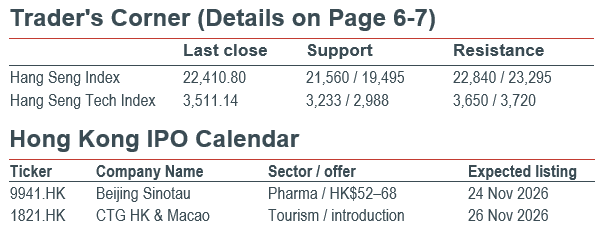
Traders' Corner
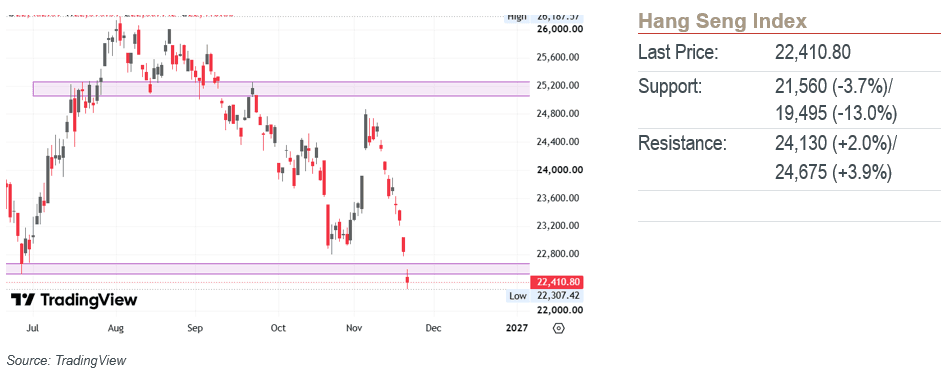
Our Technical View
Weekly Chart: Price violated its weekly previous low support zone during recent downward testing. The weekly RSI remains firmly in bearish territory and continues to fall. Provided price remains strictly capped below the violated weekly support-turned-resistance ceiling on recovery attempts, we see continued downward progression toward deeper multi-week structural lows.
Daily Chart: Price validated a decisive structural breakdown by gapping down directly below its recent support low during the latest session. The RSI remains firmly in bearish territory and continues to move lower toward the oversold zone. Provided price remains capped below the unfilled gap resistance, we see continued downward progression toward deeper support.
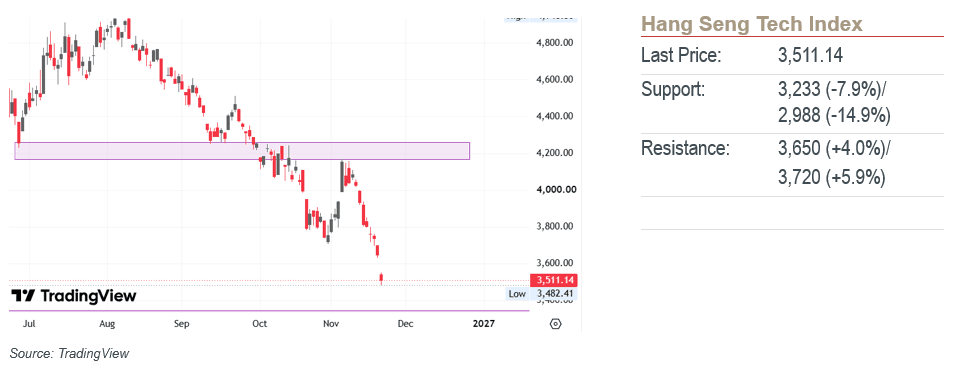
Our Technical View
Weekly Chart: Price continues to move lower after encountering firm rejection at its support-turned-resistance zone. The RSI remains firmly in bearish territory and continues to fall. Provided price remains capped below the support-turned-resistance ceiling, we see continued downward progression toward deeper support.
Daily Chart: Price validated the dominance of the ongoing markdown phase by continuing to move lower following a sharp downward gap, projecting directly toward its next major structural support zone. The RSI sits firmly in bearish territory and has entered the oversold zone. Provided price remains capped below the unfilled gap resistance, we see continued downward progression until the next support zone is tested.
Market Movers: At the 20 November close, the S&P 500 fell 3.70% for its seventh straight loss. The Nasdaq slid 5.28%, erasing its gains for the year. Taiwan’s TAIEX had already lost 6.23%. Its regulator raised short-sale margins from 130% to 150% effective Monday. Nvidia (NVDA US) fell 14.01% to US$125.53. Reuters reported that the SEC was examining its accounting. The scope remains unclear, and shares had fallen before the report. Anthropic (ANT US) slipped 8.50% to US$88.91 in its second session, still above its US$83 offer. The IPO raised US$91.6bn for Anthropic before fees, separate from a US$26bn private placement. MiniMax (0100.HK) fell 10.80% to HK$102.40 before Hang Seng Indexes announced its inclusion in the China Enterprises Index from 7 December. (AP / Reuters / Anthropic / RTHK / Hang Seng Indexes / CNA) Nvidia (NVDA US) is our Core Recommendation.
Macro: China held its one- and five-year loan prime rates at 3.00% and 3.50%, respectively, for an eighteenth month. US consumer sentiment rose to 51.5 from 48.0. Households’ year-ahead inflation expectations fell to 3.70% from 4.70% in October. Interviews ended before Friday’s selloff, so the survey has yet to capture its effect on confidence. (ChinaMoney / Michigan)
Geopolitical: President Trump told Fox News on Sunday he was inclined to resume strikes on Iran after year-end if talks failed. The prospect leaves oil shippers facing uncertainty over access through Hormuz. (Iran International)
FICC: US Treasury yields fell as investors sought safety. The two-year fell 13bp to 4.63% and the ten-year 12bp to 4.92%. December gold settled 4.62% lower at US$3,515.40/oz and silver lost 7.41% to US$41.07/oz. January Brent gained 0.64% to US$92.57/bbl and January WTI rose 1.18% to US$83.41/bbl. (US Treasury / eOption / Newsquawk)
AI
Accounting inquiry adds to Nvidia’s regulatory exposure. Nvidia (NVDA US) fell 14.01% to US$125.53, extending a decline already under way when Reuters reported that US securities regulators were examining its accounting. Reuters could not establish which accounting practices were under review. The SEC declined to comment and Nvidia did not immediately respond. On Sunday, Treasury Secretary Scott Bessent said he had contacted Nvidia’s management and still wanted answers about advanced chips reaching China. The two inquiries leave investors weighing the quality of financial disclosures alongside access to overseas customers. (Reuters / CBS / US closing prices) Nvidia (NVDA US) is our Core Recommendation.
Anthropic completes its enlarged IPO as the shares retreat. Anthropic (ANT US) closed its second Nasdaq session at US$88.91, down 8.50% from its debut close but still 7.12% above the US$83 offer. Underwriters exercised the full option for 147m extra shares. The IPO raised US$93.5bn gross, including US$91.6bn for the company and the balance for selling shareholders. A separate US$26bn placement with seven technology groups closed at the same price. The deals strengthen Anthropic’s funding while tying major chip and cloud suppliers more closely to a customer. (Anthropic / Stock Analysis)
Oracle says financing is in place for its OpenAI buildout. After the US close, Oracle (ORCL US) said it had secured the capital needed for its OpenAI infrastructure contract, including vendor financing. Its Abilene site is nearly complete, and its next gigawatt-scale campus at Shackelford has received its permits. Oracle expects positive free cash flow in the second half of fiscal 2028 and targets more than US$30bn for fiscal 2029. Delivering the sites on schedule is the next test of whether the financing can translate into cash generation. (Oracle / Reuters)
A shift in Google’s chip mix could cut Broadcom orders. Broadcom (AVGO US) fell 12.19% to US$304.41 as semiconductor shares sold off. TF International Securities analyst Ming-Chi Kuo estimated that Google had reduced planned 2027 shipments of the Broadcom-designed TPU 8i by about 1m units, or roughly 20%. His supplier survey pointed to a shift towards a competing design from MediaTek. Neither Google nor Broadcom confirmed the change. The distinction matters for Broadcom because a change in the mix of chips could cost it orders even if Google maintains overall computing investment. (Stock Analysis / Investing.com / US closing prices) Broadcom (AVGO US) and Alphabet (GOOGL US) are our Core Recommendations.
Americas
Intuit’s slower sales outlook weighs on its first session after results. Intuit (INTU US) fell 12.77% to US$270.44 after revising its fiscal 2027 revenue guidance to US$23.08bn–23.37bn, or 8%–9% growth, reflecting a change in its Credit Karma forecast. First-quarter revenue increased 12% YoY to US$4.4bn, while adjusted diluted EPS rose 56% to US$2.91. Management maintained its annual earnings guidance. The gap between slower forecast sales growth and faster earnings growth makes cost control important to delivery. (Intuit / US closing prices)
Communications demand drives Keysight’s earnings growth. Keysight Technologies (KEYS US) fell 7.07% to US$261.51 in its first session after posting fourth-quarter results. Revenue reached US$1.99bn against US$1.42bn a year earlier, while adjusted EPS rose to US$3.61 from US$1.91. Communications revenue increased 51% YoY to about US$1.50bn, including 73% growth in commercial communications. Test demand was strongest in commercial networks, giving investors a clearer measure of where orders could be most exposed to a slowdown. (Keysight / US closing prices)
Ross expects holiday sales growth to slow. Ross Stores (ROST US) slipped 2.92% to US$213.46 in its first session after reporting quarterly sales of US$6.3bn, up 12% YoY. Comparable sales gained 8%, driven mainly by customer traffic, and EPS rose to US$1.91 from US$1.58 a year earlier. The off-price retailer maintained a 4%–5% comparable-sales growth target for the holiday quarter against 9% growth last year. Sustained traffic will matter more as the comparison becomes tougher. (Ross Stores / US closing prices)
Greater China
Alibaba gains as cloud growth offsets a bigger cash outflow. Alibaba (9988.HK) rose 3.48% to HK$83.35 in its first Hong Kong session after results, against a 3.78% fall in the Hang Seng TECH Index. September-quarter revenue grew 10% YoY to RMB271.5bn, while recurring cloud revenue from external customers grew 67%. The company spent more to build cloud infrastructure. Free cash outflow widened to RMB34.5bn from RMB21.8bn a year earlier. The contrast gives investors two measures to track as demand rises: recurring revenue and the cash needed to support it. (Alibaba / Hong Kong close) Alibaba (9988.HK) is our Core Recommendation.
NetEase loses almost a fifth as Hong Kong trades its results. NetEase (9999.HK) fell 17.60% to HK$154.00 in its first full Hong Kong session after reporting third-quarter earnings. Group revenue fell 1.8% YoY to RMB27.9bn. Games and related services, its largest segment, posted a 1.7% decline to RMB22.9bn. Gross profit nevertheless rose 4.8% to RMB19.0bn and operating expenses fell 5.4%. The next test of the games pipeline is Ananta, scheduled for a global launch on 15 January. (NetEase / FactSet / Hong Kong closing prices)
Kuaishou’s ad sales fall despite a larger audience. Kuaishou (1024.HK) dropped 11.37% to HK$20.42 in the first session after its results. Third-quarter revenue fell about 11% YoY to RMB31.6bn. Online marketing sales fell 11.1% to RMB17.9bn even as monthly active users grew 12% to 818.5m. The group booked a RMB959m loss against a RMB4.5bn profit a year earlier. E-commerce competition weighed on what merchants spent on the platform, limiting the earnings benefit from audience growth. (Kuaishou / Hong Kong closing prices)
MiniMax joins the China Enterprises Index after a double-digit fall. MiniMax (0100.HK) closed 10.8% lower at HK$102.40 before Hang Seng Indexes announced its quarterly review. MiniMax and Z.AI (2513.HK) will join the 50-member Hang Seng China Enterprises Index, replacing Postal Savings Bank of China (1658.HK) and Shenzhou International (2313.HK). The changes take effect on 7 December after implementation at the 4 December close. Funds tracking the index have a date for adjusting their holdings. Friday’s price fall preceded the announcement. (Hang Seng Indexes / Hong Kong closing prices)
Asia ex. China
Taiwan raises short-selling margins after the chip rout. Taiwan Semiconductor Manufacturing (2330 TT, TSM US) fell 4.76% to NT$2,000 as the Taiex lost 6.23% to 36,033.29. Odd-lot turnover in TSMC reached NT$24.12bn on Friday, the highest of any main-board company. Over the weekend the regulator raised the minimum margin for short selling to 150% from 130%, effective Monday. The change requires more collateral to maintain short exposure as the market reopens. (Taiwan closing prices / CNA trading / CNA policy) Taiwan Semiconductor Manufacturing (TSM US) is our Core Recommendation.
Samsung and SK hynix lead a broad Korean sell-off. Samsung Electronics (005930 KS) fell 7.01% to ₩183,100 and SK hynix (000660 KS) lost 5.92% to ₩1,113,000 amid concern over US chip export restrictions. The Kospi dropped 5.21% to 4,869.96. Both the main and junior exchanges briefly suspended program sell orders. Foreign investors sold a net ₩1.13tn, while individuals bought ₩1.59tn. The flow figures show domestic buyers absorbed stock as foreigners reduced exposure to the market. (Korea Exchange / Korean close) SK hynix (SKHY US) is our Investment Opportunity.
SoftBank’s AI exposure weighs on its Tokyo shares. SoftBank Group (9984 JP) fell 14.48% to ¥3,025 as technology holdings sold off across Asia. After Anthropic’s US debut, investors had a public price for one of OpenAI’s closest competitors. SoftBank said in October that its cumulative OpenAI investment had reached US$64.6bn for an approximately 13% stake after completing a US$30bn follow-on investment. The difference matters to shareholders because OpenAI is privately held and SoftBank’s stake has no daily quoted price. (SoftBank / Investing.com / Tokyo closing prices)
Japan Tobacco cuts its dividend after losing control of its Russian units. Japan Tobacco (2914 JP) fell 10.11% to ¥5,265 in the first session following its guidance cut. The company expects to recognise a ¥1.377tn loss on deconsolidating the subsidiaries. It now forecasts a ¥724bn full-year loss attributable to shareholders, against its previous ¥662bn profit forecast. The projected annual dividend falls to ¥204 per share from ¥272, including a halving of the expected year-end payment to ¥68. The dividend reduction extends the impact of the accounting charge to shareholder income. (Japan Tobacco / Tokyo closing prices)
Singapore banks fall as selling reaches almost the entire STI. The Straits Times Index lost 2.05% to 4,975.17. Of its 30 members, 26 declined and four were unchanged. DBS (D05 SP) fell 1.83% to S$66.11, while OCBC (O39 SP) lost S$0.88 to S$26.54 and UOB (U11 SP) fell S$0.72 to S$35.42. Across the exchange, decliners outnumbered gainers 493 to 163 on turnover of S$2.6bn. The breadth of the decline shows the weakness extended beyond the three banks. (The Business Times / Singapore closing prices)
EMEA and Others
ASML slide spreads the semiconductor sell-off to Europe. ASML (ASML NA) fell 9.33% to €1,168.00 in Amsterdam as investors cut exposure to suppliers of chipmaking equipment. The STOXX Europe 600 Technology sector lost 5.39%, against a 2.00% decline in the broad STOXX 600. ASM International, Infineon and STMicroelectronics also fell. Industrial suppliers linked to AI construction, including Schneider Electric and Legrand, traded lower as well. The sector moves show the reassessment reached both chip production and data-centre infrastructure. (FactSet / Amsterdam closing prices)
Middle East disruption squeezes Vallourec’s margin. Vallourec (VK FP) lost 14.57% in Paris after reporting a 10% YoY revenue decline to US$956m. Third-quarter EBITDA fell to US$181m from US$244m a year earlier, and the margin narrowed four percentage points to 18.9%. The tube maker cited additional costs in the Middle East and expects much of that cost to be reimbursed over coming quarters. Full-year EBITDA guidance of US$760m–800m leaves investors watching the timing of the recovery. (Vallourec / Paris closing prices)
Traders' Corner
Our Technical View
Weekly Chart: Price violated its weekly previous low support zone during recent downward testing. The weekly RSI remains firmly in bearish territory and continues to fall. Provided price remains strictly capped below the violated weekly support-turned-resistance ceiling on recovery attempts, we see continued downward progression toward deeper multi-week structural lows.
Daily Chart: Price validated a decisive structural breakdown by gapping down directly below its recent support low during the latest session. The RSI remains firmly in bearish territory and continues to move lower toward the oversold zone. Provided price remains capped below the unfilled gap resistance, we see continued downward progression toward deeper support.
Our Technical View
Weekly Chart: Price continues to move lower after encountering firm rejection at its support-turned-resistance zone. The RSI remains firmly in bearish territory and continues to fall. Provided price remains capped below the support-turned-resistance ceiling, we see continued downward progression toward deeper support.
Daily Chart: Price validated the dominance of the ongoing markdown phase by continuing to move lower following a sharp downward gap, projecting directly toward its next major structural support zone. The RSI sits firmly in bearish territory and has entered the oversold zone. Provided price remains capped below the unfilled gap resistance, we see continued downward progression until the next support zone is tested.
Disclosures and disclaimers
This report is provided subject to, and must be read together with, the full Disclosures / Disclaimers available at this link, which are incorporated by reference into this report. In particular, this report is intended for general circulation and informational purposes only and does not constitute personal investment advice or a recommendation to buy or sell any investment product or security. You should independently evaluate the information and, where necessary, seek advice from a qualified financial adviser regarding the suitability of any investment. Analyst certifications required under applicable regulations, including SEC Regulation AC (where relevant), are included in this report. By accessing, receiving or using this report, you acknowledge that you have read, understood and agreed to be bound by the Disclosures / Disclaimers, as may be amended, supplemented or updated from time to time.


