

Wealth Daily
AI Debt Grows As Luxury Stocks Diverge
Today’s Must-Know News
Overnight Markets
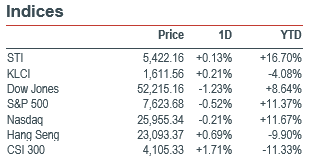
Market Movers: At the 23 October close, the S&P 500 fell 0.52%. Amazon (AMZN US) lost 0.95%; separately, in a post-close Reuters report, Jassy said major AWS capacity is largely committed through 2027, with significant 2028 bookings. L’Oréal (OR.PA) rose 5.64% after sales beat forecasts, while Kering (KER. PA) slumped 16.57% following results showing Gucci comparable revenue down 6% YoY. The divergence between beauty and luxury underlines the need to distinguish company execution from a broad consumer recovery. Musk said on Sunday that SpaceX (SPCX US) raised US$40bn in debt for GPUs, mainly through callable borrowing. Deliveries are expected in Q1 and Q2, with little current-quarter effect. The announcement follows the cash-market close, leaving its share-price impact untested. The funding supports planned AI infrastructure capacity, but deployment timing and debt servicing remain key execution risks. (Reuters / Reuters / Kering / Market data / Reuters) Amazon (AMZN US) is our Core Recommendation.
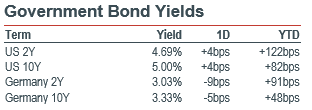
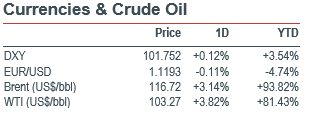
FICC: December Brent settled 3.14% higher at US$116.72/bbl and WTI rose 3.82% to US$103.27/bbl as supply fears intensified. Subsequently, Saudi Arabia's coalition reported intercepting drones and missiles on Sunday, while two Riyadh airport terminals reopened. The weekend developments keep energy disruption risk in focus; higher fuel costs threaten importer margins and complicate inflation control. Separately, the U.S. Treasury 10-year par yield rose 4bps to 5.00%, reinforcing sensitivity to financing costs. (Reuters / Reuters / U.S. Treasury)
AI
• AWS reservations extend cloud-demand visibility into 2028. Amazon (AMZN US) CEO Andy Jassy said major AWS capacity for 2026 is sold out, 2027 is largely committed and a substantial portion of 2028 is reserved. Against planned 2026 capital spending of about US$220bn, the comments strengthen visibility into demand from AI labs and enterprises. Capacity delivery, utilisation and returns on that spending remain the important tests. (Reuters) Amazon (AMZN US) is our Core Recommendation.
• SpaceX secures a new US$40bn commitment to AI chips. SpaceX (SPCX US) has closed US$40bn of debt financing for GPUs, Elon Musk said on Sunday. Reuters reported that Starlink and launch revenue, alongside investment-grade status, helped preserve access to credit. The borrowing is callable, with chips expected in Q1 and Q2 and limited impact to financials this quarter. This supports planned AI capacity, while delivery timing and financing costs remain central to the investment case. (Reuters)
• Texas seeks a court-supervised gate for new OpenAI models. OpenAI faces a Texas consumer-protection lawsuit seeking to bar ChatGPT access for minors and require court-approved independent safety review before new models reach Texas users. These are requested remedies, not an order already in force. OpenAI said it supports industry-wide safety standards. Separately, its new security disclosure describes offline frontier training; training resumed on 1 October, so the fresh event is disclosure rather than a restart. (Texas Attorney General / Texas Tribune / OpenAI)
• MiniMax opens deployment options with downloadable weights. MiniMax (0100.HK) rose 16.74% after releasing M3.1 Flash weights before the Hong Kong close. Its model contains approximately 428bn parameters, with 23bn activated per token. Downloadable weights give developers more control over deployment and could broaden enterprise adoption. The release strengthens its distribution position, although model availability alone does not establish incremental revenue or profitable usage. (Company / NewTimeSpace / Market data)
Americas
• Meta brings Sundial analytics technology and staff in-house. Meta Platforms (META US) confirmed to Axios that it is acquiring Sundial, the AI data-analytics platform founded by former Meta executives Julie Zhuo and Chandra Narayanan. The team and technology will join Meta's data organisation, and Sundial will stop serving external customers when the deal closes. No purchase price was disclosed. The acquisition strengthens internal analytics and agent tooling, but provides no quantified basis yet for estimating earnings accretion. (Axios) Meta Platforms (META US) is our Core Recommendation.
• Cybersecurity rally comes with an important exploitation distinction. CrowdStrike (CRWD US) rose 8.25% at the U.S. close, while Palo Alto Networks (PANW US) gained 7.22%. CrowdStrike's fresh PHP2Shell assessment says PHP powers about 70% of websites, but it had not observed successful exploitation in the wild or its honeypots. The disclosure supports attention to defensive spending while distinguishing a widely deployed technology from confirmed compromised systems; the share moves alone do not establish an earnings benefit. (CrowdStrike / Market data / Market data)
• Apple begins the retail test of its first foldable iPhone. Apple (AAPL US) opened worldwide retail availability for iPhone Duo, its first foldable iPhone, including U.S. stores in New York and Austin. The previously announced U.S. starting price is US$1,999. Sales volumes, returns and product mix will determine whether the premium format broadens revenue. (Apple / Apple)
• Bloom’s rapid growth meets a negative earnings reaction. Bloom Energy (BE US) fell 11.24% in the first cash session after results despite third-quarter revenue of US$1.236bn, up 138.1% YoY. It raised full-year revenue guidance to US$4.4bn–4.6bn, implying 122% growth at the midpoint. Quarterly operating cash flow was negative US$27.1mn versus positive US$19.7mn a year earlier. (Bloom Energy / Market data)
• Western Digital lifts storage guidance as shares retreat. Western Digital (WDC US) fell 2.97% in the first cash session after fiscal first-quarter revenue rose 55% YoY to US$4.38bn and adjusted EPS increased 161% to US$4.64. Management forecast next-quarter revenue of US$5.0bn–5.2bn, up 66%–72% YoY, citing exabyte demand and pricing. The figures support storage demand visibility, while the negative share reaction shows that strong reported growth does not by itself secure a positive market response. (Western Digital / Market data)
• American Express raises guidance on resilient card spending. American Express (AXP US) reported quarterly revenue of US$20.1bn, up 9% YoY, and adjusted EPS of US$4.68, up 13%, while lifting full-year adjusted EPS guidance to US$17.60–17.90. Reported EPS rose 31% to US$5.42 but included a disposal gain net of restructuring costs. Shares fell 3.68% at the U.S. close. Separating that one-off benefit from underlying earnings gives a clearer measure of premium-consumer resilience and operating performance. (American Express/SEC / Market data)
• AbbVie adds an at-home start for Skyrizi in Crohn’s disease. AbbVie (ABBV US) said the FDA approved subcutaneous induction for Skyrizi in adults with moderately to severely active Crohn's disease, allowing patients to begin treatment at home using an on-body injector. In the Phase 3 AFFIRM trial, clinical remission at week 12 was 56% versus 30% for placebo across the total population. (AbbVie)
Greater China
• Tencent opens interactive world generation to developers. Tencent (0700.HK) released Hy-Nomas weights after the Hong Kong close, then added Apache 2.0 licensing on Saturday. Its model supports interactive text and camera controls and outputs 720-by-1280 video at 24 frames per second. That figure describes playback, not generation speed. Open deployment could support gaming and simulation tools, while competitive performance and the earnings contribution remain to be demonstrated. (Company) Tencent (0700.HK) is our Core Recommendation.
• HSBC brings its stablecoin into everyday payments. HSBC (0005.HK) launched its Hong Kong dollar stablecoin RedCoin on PayMe, with wallet activation being rolled out to more than 3.3mn users. It supports transfers and payments at over 100,000 merchants. Planned tokenised-investment subscriptions would extend the product beyond payments, but that functionality is still forthcoming. The existing customer network provides distribution scale; sustained usage will determine its commercial value. (Company / Cointelegraph) HSBC (0005.HK) is our Core Recommendation.
• GigaDevice joins a broad AI-hardware rebound. GigaDevice Semiconductor (3986.HK) gained 8.62% to HK$347.80 as Hong Kong technology shares recovered. The Hang Seng Tech Index advanced 2.05%, and 19 of the 20 AI names tracked by NewTimeSpace finished higher. Such breadth supports a sector-rebound interpretation rather than a new company earnings catalyst. Sustaining the recovery will require firmer evidence on memory demand, pricing and profits. (NewTimeSpace / Market data) GigaDevice Semiconductor (3986.HK) is our Investment Opportunity.
• Citi secures approval for onshore securities expansion. Citigroup (C US) received approval for a wholly owned Chinese securities company with RMB1.2bn of registered capital. The Shanghai venture will offer underwriting, brokerage, research and principal trading, extending its access to domestic capital markets. Statutory and regulatory procedures remain before operations begin. The approval enlarges Citi's addressable franchise, while the pace of client acquisition and local deal activity will determine the earnings benefit. (Company / Bloomberg)
Asia ex. China
• Infosys cuts growth guidance despite large deal wins. Infosys (INFY US) fell 6.58% after reducing FY27 constant-currency revenue-growth guidance to 1%-2% from 1.5%-3%. Second-quarter revenue was US$5.145bn, up 1.3% YoY as reported and 1.5% in constant currency; the operating margin held at 21%. Large deal wins of US$5.2bn provide a pipeline, but pricing pressure and subdued volumes suggest conversion into near-term revenue remains the key hurdle. (Company / CNBC-TV18 / Market data)
• Sembcorp gains a new low-carbon fuel channel. Sembcorp Industries (U96.SI) was appointed an approved aggregator under Singapore's biomethane sandbox. Its allocation allows annual imports of up to 7.18trn British thermal units, equivalent to about 120MW of electricity generation. This expands the group's offering to data centres and industrial customers seeking lower-carbon power. Commercial returns will depend on securing competitively priced feedstock, reliable supply and customers for the new fuel. (Company / Business Times)
EMEA and Others
• L’Oréal's growth beat supports premium-beauty demand. L’Oréal (OR.PA) rose 5.64% in the first Paris session after its results. Third-quarter sales reached €11.56bn, up 11.9% YoY as reported and 7.7% on an adjusted like-for-like basis, above the 5.9% consensus. Fragrances, premium haircare and stronger Chinese beauty demand supported performance. The breadth of growth points to resilient product demand, although currency and acquisition effects make reported and underlying growth rates different. (Company / Reuters / Market data)
• Safran's aftermarket slowdown overshadows revenue growth. Safran (SAF.PA) dropped 10.00% despite third-quarter revenue rising 13.4% organically YoY to €9bn and unchanged full-year guidance. Propulsion aftermarket revenue grew 18.7%, but analysts highlighted slower growth and the risk that high fuel costs restrain airline capacity. The results show that healthy absolute growth can disappoint demanding expectations; spare-parts demand and maintenance activity remain central to the earnings outlook. (Reuters / Market data)
• Kering's selloff underlines Gucci's recovery challenge. Kering (KER.PA) fell 16.57% in the first Paris session following its sales update. Third-quarter group revenue was €3.345bn, flat as reported and down 1% YoY on a comparable basis. Gucci sales fell 6% comparably to €1.291bn, with directly operated retail sales down 9%. Better performance elsewhere has yet to offset Gucci's weakness, leaving customer traffic and product renewal central to the turnaround. (Company / Reuters / Market data)
• Norges opposes key parts of Monte dei Paschi's defence. Monte dei Paschi di Siena (BMPS.MI) faces resistance from Norges Bank Investment Management to proposed bids for Banco BPM and Banca Generali. The fund, which held 2.98% at end-2025, also opposes the proposed Mediobanca merger into MPS and an extraordinary dividend. Its Saturday disclosure complicates management's defence against Intesa Sanpaolo, highlighting shareholder-return scrutiny and execution risk across the planned transactions. (Reuters)
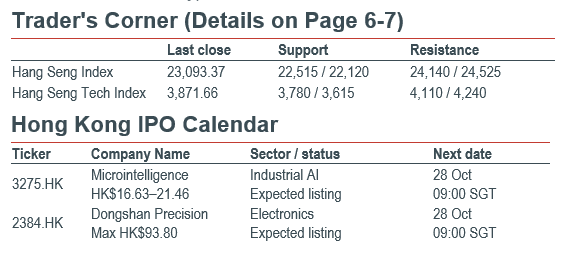
Traders' Corner
Our Technical View
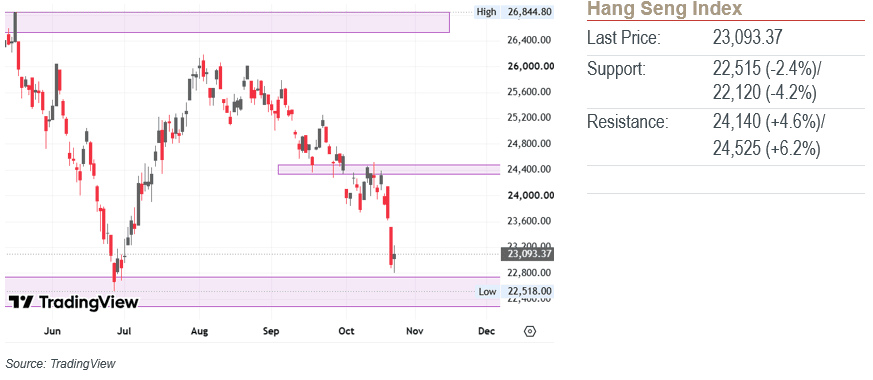
Weekly Chart: Price maintained its dominant mark-down trajectory, accelerating downward toward the next support. While the broader swing structure remains aligned in a lower-high and lower-low hierarchy, the proximity to this support zone introduces the probability of a corrective response. The RSI is beneath its neutral 50 midline and continues to slope downward with negative velocity. However, as price approaches this support, it often triggers temporary buyer re-entry. Provided the support zone holds on initial contact, we could see an interim corrective pullback before any structural continuation of the broader mark-down sequence.
Daily Chart: Price printed a neutral Doji candlestick on Friday, signaling indecision and a temporary pause in prevailing sell-side momentum. Nestled within the prior session’s real body, this price compression establishes a potential bullish Harami reversal pattern. The structural pivot hinges on Monday’s session close: a decisive daily close above the 23,513 trigger threshold is required to validate the Harami confirmation, shifting tactical momentum toward a corrective bounce. Until 23,513 is decisively reclaimed on a closing basis, the structural hierarchy remains vulnerable to downside continuation, though a confirmed close above this key level opens the path toward upper overhead resistance.
Our Technical View
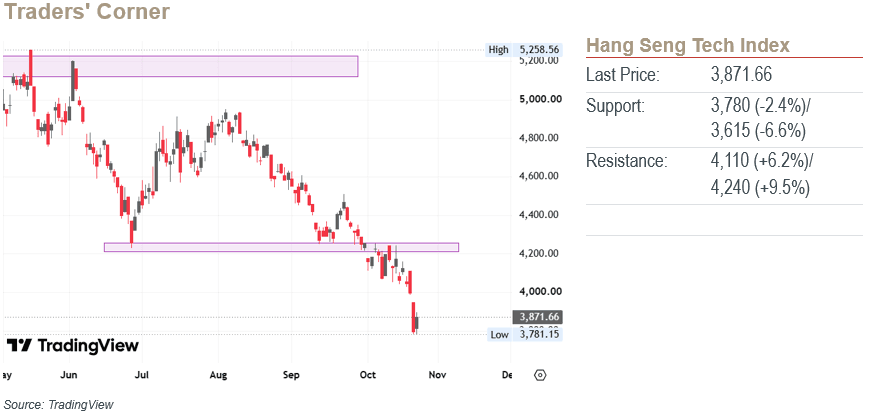
Weekly Chart: Price rejected upon retesting its support-turned-resistance zone. The RSI continues to slope downward with negative velocity toward oversold parameters. As long as price remains capped beneath this defended resistance, we see continued downward expansion toward deeper demand targets.
Daily Chart: Price exhibits deceleration following a sustained mark-down sequence, developing a potential bullish Harami pattern. Although the RSI remains anchored in a falling trajectory near oversold parameters—the narrowing real-body price action within the preceding candle's range suggests an emerging structural floor. The tactical pivot relies on Monday’s session close: a decisive daily close above the 3,950 trigger baseline is required to validate pattern completion, shift momentum toward a corrective rebound. Until 3,950 is decisively reclaimed on a closing basis, the primary mark-down hierarchy remains vulnerable to downside continuation.
Market Movers: At the 23 October close, the S&P 500 fell 0.52%. Amazon (AMZN US) lost 0.95%; separately, in a post-close Reuters report, Jassy said major AWS capacity is largely committed through 2027, with significant 2028 bookings. L’Oréal (OR.PA) rose 5.64% after sales beat forecasts, while Kering (KER. PA) slumped 16.57% following results showing Gucci comparable revenue down 6% YoY. The divergence between beauty and luxury underlines the need to distinguish company execution from a broad consumer recovery. Musk said on Sunday that SpaceX (SPCX US) raised US$40bn in debt for GPUs, mainly through callable borrowing. Deliveries are expected in Q1 and Q2, with little current-quarter effect. The announcement follows the cash-market close, leaving its share-price impact untested. The funding supports planned AI infrastructure capacity, but deployment timing and debt servicing remain key execution risks. (Reuters / Reuters / Kering / Market data / Reuters) Amazon (AMZN US) is our Core Recommendation.
FICC: December Brent settled 3.14% higher at US$116.72/bbl and WTI rose 3.82% to US$103.27/bbl as supply fears intensified. Subsequently, Saudi Arabia's coalition reported intercepting drones and missiles on Sunday, while two Riyadh airport terminals reopened. The weekend developments keep energy disruption risk in focus; higher fuel costs threaten importer margins and complicate inflation control. Separately, the U.S. Treasury 10-year par yield rose 4bps to 5.00%, reinforcing sensitivity to financing costs. (Reuters / Reuters / U.S. Treasury)
AI
• AWS reservations extend cloud-demand visibility into 2028. Amazon (AMZN US) CEO Andy Jassy said major AWS capacity for 2026 is sold out, 2027 is largely committed and a substantial portion of 2028 is reserved. Against planned 2026 capital spending of about US$220bn, the comments strengthen visibility into demand from AI labs and enterprises. Capacity delivery, utilisation and returns on that spending remain the important tests. (Reuters) Amazon (AMZN US) is our Core Recommendation.
• SpaceX secures a new US$40bn commitment to AI chips. SpaceX (SPCX US) has closed US$40bn of debt financing for GPUs, Elon Musk said on Sunday. Reuters reported that Starlink and launch revenue, alongside investment-grade status, helped preserve access to credit. The borrowing is callable, with chips expected in Q1 and Q2 and limited impact to financials this quarter. This supports planned AI capacity, while delivery timing and financing costs remain central to the investment case. (Reuters)
• Texas seeks a court-supervised gate for new OpenAI models. OpenAI faces a Texas consumer-protection lawsuit seeking to bar ChatGPT access for minors and require court-approved independent safety review before new models reach Texas users. These are requested remedies, not an order already in force. OpenAI said it supports industry-wide safety standards. Separately, its new security disclosure describes offline frontier training; training resumed on 1 October, so the fresh event is disclosure rather than a restart. (Texas Attorney General / Texas Tribune / OpenAI)
• MiniMax opens deployment options with downloadable weights. MiniMax (0100.HK) rose 16.74% after releasing M3.1 Flash weights before the Hong Kong close. Its model contains approximately 428bn parameters, with 23bn activated per token. Downloadable weights give developers more control over deployment and could broaden enterprise adoption. The release strengthens its distribution position, although model availability alone does not establish incremental revenue or profitable usage. (Company / NewTimeSpace / Market data)
Americas
• Meta brings Sundial analytics technology and staff in-house. Meta Platforms (META US) confirmed to Axios that it is acquiring Sundial, the AI data-analytics platform founded by former Meta executives Julie Zhuo and Chandra Narayanan. The team and technology will join Meta's data organisation, and Sundial will stop serving external customers when the deal closes. No purchase price was disclosed. The acquisition strengthens internal analytics and agent tooling, but provides no quantified basis yet for estimating earnings accretion. (Axios) Meta Platforms (META US) is our Core Recommendation.
• Cybersecurity rally comes with an important exploitation distinction. CrowdStrike (CRWD US) rose 8.25% at the U.S. close, while Palo Alto Networks (PANW US) gained 7.22%. CrowdStrike's fresh PHP2Shell assessment says PHP powers about 70% of websites, but it had not observed successful exploitation in the wild or its honeypots. The disclosure supports attention to defensive spending while distinguishing a widely deployed technology from confirmed compromised systems; the share moves alone do not establish an earnings benefit. (CrowdStrike / Market data / Market data)
• Apple begins the retail test of its first foldable iPhone. Apple (AAPL US) opened worldwide retail availability for iPhone Duo, its first foldable iPhone, including U.S. stores in New York and Austin. The previously announced U.S. starting price is US$1,999. Sales volumes, returns and product mix will determine whether the premium format broadens revenue. (Apple / Apple)
• Bloom’s rapid growth meets a negative earnings reaction. Bloom Energy (BE US) fell 11.24% in the first cash session after results despite third-quarter revenue of US$1.236bn, up 138.1% YoY. It raised full-year revenue guidance to US$4.4bn–4.6bn, implying 122% growth at the midpoint. Quarterly operating cash flow was negative US$27.1mn versus positive US$19.7mn a year earlier. (Bloom Energy / Market data)
• Western Digital lifts storage guidance as shares retreat. Western Digital (WDC US) fell 2.97% in the first cash session after fiscal first-quarter revenue rose 55% YoY to US$4.38bn and adjusted EPS increased 161% to US$4.64. Management forecast next-quarter revenue of US$5.0bn–5.2bn, up 66%–72% YoY, citing exabyte demand and pricing. The figures support storage demand visibility, while the negative share reaction shows that strong reported growth does not by itself secure a positive market response. (Western Digital / Market data)
• American Express raises guidance on resilient card spending. American Express (AXP US) reported quarterly revenue of US$20.1bn, up 9% YoY, and adjusted EPS of US$4.68, up 13%, while lifting full-year adjusted EPS guidance to US$17.60–17.90. Reported EPS rose 31% to US$5.42 but included a disposal gain net of restructuring costs. Shares fell 3.68% at the U.S. close. Separating that one-off benefit from underlying earnings gives a clearer measure of premium-consumer resilience and operating performance. (American Express/SEC / Market data)
• AbbVie adds an at-home start for Skyrizi in Crohn’s disease. AbbVie (ABBV US) said the FDA approved subcutaneous induction for Skyrizi in adults with moderately to severely active Crohn's disease, allowing patients to begin treatment at home using an on-body injector. In the Phase 3 AFFIRM trial, clinical remission at week 12 was 56% versus 30% for placebo across the total population. (AbbVie)
Greater China
• Tencent opens interactive world generation to developers. Tencent (0700.HK) released Hy-Nomas weights after the Hong Kong close, then added Apache 2.0 licensing on Saturday. Its model supports interactive text and camera controls and outputs 720-by-1280 video at 24 frames per second. That figure describes playback, not generation speed. Open deployment could support gaming and simulation tools, while competitive performance and the earnings contribution remain to be demonstrated. (Company) Tencent (0700.HK) is our Core Recommendation.
• HSBC brings its stablecoin into everyday payments. HSBC (0005.HK) launched its Hong Kong dollar stablecoin RedCoin on PayMe, with wallet activation being rolled out to more than 3.3mn users. It supports transfers and payments at over 100,000 merchants. Planned tokenised-investment subscriptions would extend the product beyond payments, but that functionality is still forthcoming. The existing customer network provides distribution scale; sustained usage will determine its commercial value. (Company / Cointelegraph) HSBC (0005.HK) is our Core Recommendation.
• GigaDevice joins a broad AI-hardware rebound. GigaDevice Semiconductor (3986.HK) gained 8.62% to HK$347.80 as Hong Kong technology shares recovered. The Hang Seng Tech Index advanced 2.05%, and 19 of the 20 AI names tracked by NewTimeSpace finished higher. Such breadth supports a sector-rebound interpretation rather than a new company earnings catalyst. Sustaining the recovery will require firmer evidence on memory demand, pricing and profits. (NewTimeSpace / Market data) GigaDevice Semiconductor (3986.HK) is our Investment Opportunity.
• Citi secures approval for onshore securities expansion. Citigroup (C US) received approval for a wholly owned Chinese securities company with RMB1.2bn of registered capital. The Shanghai venture will offer underwriting, brokerage, research and principal trading, extending its access to domestic capital markets. Statutory and regulatory procedures remain before operations begin. The approval enlarges Citi's addressable franchise, while the pace of client acquisition and local deal activity will determine the earnings benefit. (Company / Bloomberg)
Asia ex. China
• Infosys cuts growth guidance despite large deal wins. Infosys (INFY US) fell 6.58% after reducing FY27 constant-currency revenue-growth guidance to 1%-2% from 1.5%-3%. Second-quarter revenue was US$5.145bn, up 1.3% YoY as reported and 1.5% in constant currency; the operating margin held at 21%. Large deal wins of US$5.2bn provide a pipeline, but pricing pressure and subdued volumes suggest conversion into near-term revenue remains the key hurdle. (Company / CNBC-TV18 / Market data)
• Sembcorp gains a new low-carbon fuel channel. Sembcorp Industries (U96.SI) was appointed an approved aggregator under Singapore's biomethane sandbox. Its allocation allows annual imports of up to 7.18trn British thermal units, equivalent to about 120MW of electricity generation. This expands the group's offering to data centres and industrial customers seeking lower-carbon power. Commercial returns will depend on securing competitively priced feedstock, reliable supply and customers for the new fuel. (Company / Business Times)
EMEA and Others
• L’Oréal's growth beat supports premium-beauty demand. L’Oréal (OR.PA) rose 5.64% in the first Paris session after its results. Third-quarter sales reached €11.56bn, up 11.9% YoY as reported and 7.7% on an adjusted like-for-like basis, above the 5.9% consensus. Fragrances, premium haircare and stronger Chinese beauty demand supported performance. The breadth of growth points to resilient product demand, although currency and acquisition effects make reported and underlying growth rates different. (Company / Reuters / Market data)
• Safran's aftermarket slowdown overshadows revenue growth. Safran (SAF.PA) dropped 10.00% despite third-quarter revenue rising 13.4% organically YoY to €9bn and unchanged full-year guidance. Propulsion aftermarket revenue grew 18.7%, but analysts highlighted slower growth and the risk that high fuel costs restrain airline capacity. The results show that healthy absolute growth can disappoint demanding expectations; spare-parts demand and maintenance activity remain central to the earnings outlook. (Reuters / Market data)
• Kering's selloff underlines Gucci's recovery challenge. Kering (KER.PA) fell 16.57% in the first Paris session following its sales update. Third-quarter group revenue was €3.345bn, flat as reported and down 1% YoY on a comparable basis. Gucci sales fell 6% comparably to €1.291bn, with directly operated retail sales down 9%. Better performance elsewhere has yet to offset Gucci's weakness, leaving customer traffic and product renewal central to the turnaround. (Company / Reuters / Market data)
• Norges opposes key parts of Monte dei Paschi's defence. Monte dei Paschi di Siena (BMPS.MI) faces resistance from Norges Bank Investment Management to proposed bids for Banco BPM and Banca Generali. The fund, which held 2.98% at end-2025, also opposes the proposed Mediobanca merger into MPS and an extraordinary dividend. Its Saturday disclosure complicates management's defence against Intesa Sanpaolo, highlighting shareholder-return scrutiny and execution risk across the planned transactions. (Reuters)
Traders' Corner
Our Technical View
Weekly Chart: Price maintained its dominant mark-down trajectory, accelerating downward toward the next support. While the broader swing structure remains aligned in a lower-high and lower-low hierarchy, the proximity to this support zone introduces the probability of a corrective response. The RSI is beneath its neutral 50 midline and continues to slope downward with negative velocity. However, as price approaches this support, it often triggers temporary buyer re-entry. Provided the support zone holds on initial contact, we could see an interim corrective pullback before any structural continuation of the broader mark-down sequence.
Daily Chart: Price printed a neutral Doji candlestick on Friday, signaling indecision and a temporary pause in prevailing sell-side momentum. Nestled within the prior session’s real body, this price compression establishes a potential bullish Harami reversal pattern. The structural pivot hinges on Monday’s session close: a decisive daily close above the 23,513 trigger threshold is required to validate the Harami confirmation, shifting tactical momentum toward a corrective bounce. Until 23,513 is decisively reclaimed on a closing basis, the structural hierarchy remains vulnerable to downside continuation, though a confirmed close above this key level opens the path toward upper overhead resistance.
Our Technical View
Weekly Chart: Price rejected upon retesting its support-turned-resistance zone. The RSI continues to slope downward with negative velocity toward oversold parameters. As long as price remains capped beneath this defended resistance, we see continued downward expansion toward deeper demand targets.
Daily Chart: Price exhibits deceleration following a sustained mark-down sequence, developing a potential bullish Harami pattern. Although the RSI remains anchored in a falling trajectory near oversold parameters—the narrowing real-body price action within the preceding candle's range suggests an emerging structural floor. The tactical pivot relies on Monday’s session close: a decisive daily close above the 3,950 trigger baseline is required to validate pattern completion, shift momentum toward a corrective rebound. Until 3,950 is decisively reclaimed on a closing basis, the primary mark-down hierarchy remains vulnerable to downside continuation.
Disclosures and disclaimers
This report is provided subject to, and must be read together with, the full Disclosures / Disclaimers available at this link, which are incorporated by reference into this report. In particular, this report is intended for general circulation and informational purposes only and does not constitute personal investment advice or a recommendation to buy or sell any investment product or security. You should independently evaluate the information and, where necessary, seek advice from a qualified financial adviser regarding the suitability of any investment. Analyst certifications required under applicable regulations, including SEC Regulation AC (where relevant), are included in this report. By accessing, receiving or using this report, you acknowledge that you have read, understood and agreed to be bound by the Disclosures / Disclaimers, as may be amended, supplemented or updated from time to time.


