

Wealth Daily
AI Spending Tests Cash Returns as the Fed Holds Rates
Today’s Must-Know News
Overnight Markets
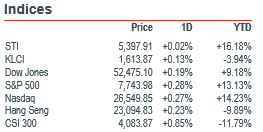
Market Movers: At the 28 October close, the S&P 500 gained 0.28%. Oracle (ORCL US) rose 10.73% after targeting at least US$30bn of FY29 free cash flow. SK Hynix ADR (SKHY US) jumped 13.30% as 3Q operating profit rose 632% YoY to KRW83.3tn and planned 2026 shareholder returns reached approximately KRW100tn, including earlier buybacks. Genmab’s US ADRs (GMAB US) surged 28.25% after its Phase 3 petosemtamab combination halved death risk versus pembrolizumab alone in first-line PD-L1-positive advanced head-and-neck cancer; regulatory review remains ahead. After the U.S. close, Alphabet (GOOGL US) reported revenue up 25% to US$127.6bn but missed consensus, with a US$9.07bn free-cash-flow deficit. Microsoft (MSFT US) reported Azure revenue up 48% and US$18.6bn free cash flow, highlighting divergent AI cash returns. (Oracle / Reuters / SK hynix / Yonhap / Alphabet / Genmab / Microsoft / Reuters / Reuters) Alphabet (GOOGL US) is our Core Recommendation; Microsoft (MSFT US) and SK Hynix ADR (SKHY US) are our Investment Opportunities.
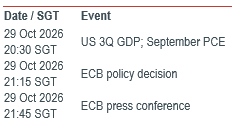
Macro: The Fed held rates at 3.75–4.00% in a 10–2 vote; both dissenters favoured a 25bp increase. The forthcoming ECB decision at 21:15 SGT is expected to leave the deposit rate at 2.50%. Watch inflation guidance and financial stress: a dovish shift could weaken the euro, while price pressures constrain easing. U.S. GDP and PCE data at 20:30 SGT test growth and inflation. (Federal Reserve / Bloomberg / ECB / Reuters poll / BEA)
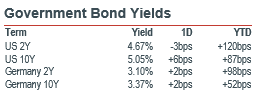
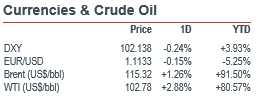
FICC: December WTI settled at US$102.78/bbl, up 2.88%, while the U.S. 10-year Treasury par yield rose 6bps to 5.05%. Higher energy costs and long-term yields pressure financing conditions, keeping energy-sensitive margins and interest-rate exposure in focus. (Market data / U.S. Treasury)
AI
• Cash burn overshadows Alphabet’s cloud expansion. Alphabet (GOOGL US) reported after the close that revenue rose 25% YoY to US$127.6bn and Google Cloud grew 103% to US$30.7bn, but free cash flow was negative US$9.07bn. EPS fell to US$2.12 from US$2.87. Google also introduced Gemini 4 Carbon for phased access by cyber defenders. Strong demand therefore remains accompanied by substantial funding needs. (Alphabet / Google) Alphabet (GOOGL US) is our Core Recommendation.
• Memory demand turns into shareholder returns at SK Hynix. SK Hynix (SKHY US) reported revenue up 328% YoY to KRW104.6tn and operating profit up 632% to KRW83.3tn. The company plans about KRW100tn of 2026 shareholder returns, including previously announced repurchases. ADRs gained 13.30% to US$164.70. Contracts covering over half of 2027–28 capacity support demand visibility; Korea’s KOSPI rose 6.63%. (SK hynix / Yonhap / Market data) SK Hynix ADR (SKHY US) is our Investment Opportunity.
• Azure demand converts into cash for Microsoft. Microsoft (MSFT US) reported after the close that fiscal first-quarter revenue rose 19% YoY to US$92.3bn, Azure revenue increased 48% to US$33.2bn and adjusted EPS advanced 18% to US$4.89. Free cash flow reached US$18.6bn. Commercial remaining performance obligations rose 73% to US$677bn, supporting demand visibility, although delayed infrastructure deliveries helped spending fall below the company’s forecast. (Microsoft / Reuters) Microsoft (MSFT US) is our Investment Opportunities.
• Cash-generation timetable set by Oracle. Oracle (ORCL US) rose 10.73% to US$144.54 after management targeted positive free cash flow in the second half of FY28 and at least US$30bn in FY29. Additional capital raising through FY30 is capped at US$20bn, excluding refinancing. Expected lower capital spending supports the plan; execution and customer concentration remain central investment risks. (Oracle / Reuters / Market data)
Americas
• Next-generation diabetes case strengthens for Eli Lilly. Eli Lilly (LLY US) reported that in an 80-week Phase 3 comparison, investigational retatrutide 12mg reduced A1C by 2.2 percentage points and weight by 20.9%, versus 1.8 points and 9.4% for Ozempic 2mg. These are efficacy-estimand results assuming continued treatment. Adverse-event discontinuations were 7.9% versus 2.7%. The efficacy strengthens competitive potential, while approval and tolerability remain important. (Lilly / Reuters) Eli Lilly (LLY US) is our Core Recommendation.
• Grid-equipment reach expands for GE Vernova. GE Vernova (GEV US) agreed to acquire Trench Group for US$9bn, funded equally with cash and debt, with completion expected in late 2027 subject to approvals. Third-quarter orders rose 96% to US$29.3bn and backlog reached US$197bn. Shares fell 1.90% to US$878.03. The acquisition adds manufacturing capacity, while financing and integration require execution. (GE Vernova / Reuters / Market data) GE Vernova (GEV US) is our Core Recommendation.
• First earnings reaction stays subdued for Visa. Visa (V US) slipped 0.31% to US$400.60 in the first cash session after results. Fiscal fourth-quarter net revenue increased 13% YoY to US$12.1bn and adjusted EPS rose 17% to US$3.48. Cross-border volume excluding intra-Europe grew 14%. The quarterly dividend rises 16% to US$0.78; client incentives growing 21% highlight the cost of sustaining payments growth. (Visa / Market data)
• Record growth coupled with capital returns at Amphenol. Amphenol (APH US) rose 3.52% to US$80.96 after third-quarter sales increased 65% YoY to US$10.2bn, including 37% organic growth, and adjusted EPS climbed 74% to US$0.80. Orders reached US$12.2bn. A new US$4bn, three-year buyback begins in January; strong data-networking demand supports expansion, while acquisitions account for a meaningful share of reported growth. (Amphenol / Market data)
• Cash-session response turns positive for Seagate. Seagate Technology (STX US) gained 4.51% to US$697.97 in the first cash session after fiscal first-quarter results. Revenue rose 61% YoY to US$4.233bn and adjusted EPS reached US$7.68 versus US$2.61. The next-quarter revenue midpoint is US$4.8bn. Pricing and cloud storage demand support profitability, while capacity discipline and sustained customer orders remain key assumptions. (Seagate / Market data)
• Earnings outlook raised at Flex as infrastructure expands. Flex (FLEX US) rose 11.61% to US$93.03 after fiscal second-quarter sales increased 25% YoY to US$8.49bn and adjusted EPS rose 49% to US$1.18. FY27 adjusted EPS guidance rises to US$4.84–5.16 from US$4.42–4.74. Preparations continue for the Cloud and Power Infrastructure spin-off; current guidance includes the business and recent acquisitions, making separation execution an important consideration. (Flex / Market data)
• AI monetisation expectations lifted by ServiceNow. ServiceNow (NOW US) reported after the close that third-quarter subscription revenue rose 21% YoY to US$3.988bn and current remaining performance obligations increased 20.5% to US$13.65bn. Management raised its year-end AI annual contract value target to US$1.7bn from US$1bn at the year’s start. The full-year free-cash-flow margin target rises to 36%, reinforcing the focus on profitable enterprise adoption. (ServiceNow)
• Outlook reflects continued disruption at Boston Scientific. Boston Scientific (BSX US) fell 5.84% to US$42.43 after third-quarter sales rose just 1.5% YoY to US$5.138bn and adjusted EPS declined to US$0.73 from US$0.75. Management now forecasts full-year adjusted EPS of US$3.16–3.18 and fourth-quarter sales falling 1–3%. Recovery from its cybersecurity incident remains an operational priority, while the sales outlook limits near-term earnings visibility. (Boston Scientific / Market data)
• Strong cash generation directed towards returns at Phillips 66. Phillips 66 (PSX US) rose 1.95% to US$273.76 after the refiner reported third-quarter adjusted earnings of US$5.6bn, or US$14.08 per share, with 98% refining utilisation. It returned US$2.8bn to shareholders and reduced total debt by US$2bn to US$18.5bn. Strong refining economics support distributions, although exposure to volatile margins keeps the earnings base cyclical. (Phillips 66 / Market data)
• Slowing growth outlook overshadows F5 results. F5 (FFIV US) fell 20.43% to US$365.53 in the first cash session after results. Fiscal fourth-quarter revenue rose 13% YoY to US$917m, but FY27 revenue growth is guided to 8–9%, versus 11% in FY26. Adjusted EPS was US$4.42 versus US$4.39. A new US$1.5bn buyback authorisation provides support; slower growth expectations still weigh on the outlook. (F5 / Market data)
Greater China
• PetroChina benefits from stronger energy prices. PetroChina (0857.HK) reported Q3 attributable profit of RMB51.84bn, up 21.6% YoY on restated comparatives, after Hong Kong trading ended. Revenue increased 10.4% to RMB793.57bn. Nine-month refined-fuel sales fell 5.1% while operating cash flow rose 8.8% to RMB373.54bn. Stronger commodity earnings support cash generation, although weaker fuel volumes show domestic demand remains uneven. (Company / Egypt Oil & Gas) PetroChina (0857.HK) is our Core Recommendation.
• Ping An operating resilience contrasts with weaker headline earnings. Ping An (2318.HK) disclosed nine-month operating profit of RMB125.91bn, up 8.3% YoY, after Hong Kong’s close. Net profit fell 27.3% to RMB96.65bn and life-and-health new-business value declined 13.3% to RMB30.99bn. The property-and-casualty combined ratio improved 1.4 percentage points to 95.6%, supporting underwriting returns despite weaker investment-sensitive earnings and life sales. (Company / Rein Asia)
• Sands China extends maturities at higher borrowing costs. Sands China (1928.HK) priced US$1bn of senior notes: US$700m at 6.4% due 2032 and US$300m at 6.7% due 2033. Approximately US$989m of proceeds will help redeem US$700m of 2.3% notes due 2027, repay revolving debt and fund operations. The refinancing reduces near-term maturity pressure but replaces inexpensive debt with materially higher coupons. (Company / Asia Gaming Brief)
• China Overseas grows sales value despite lower contracted area. China Overseas Land & Investment (0688.HK) reported nine-month contracted sales of RMB181.04bn, up 6.2% YoY, despite a 19.2% decline in area sold to 6.12m square metres. Q3 revenue reached RMB32.8bn and operating profit RMB1.95bn. Its RMB49.22bn land purchases concentrate expansion in key cities, increasing exposure to stronger markets while requiring continued cash discipline. (Company / The Standard)
Asia ex. China
• Hitachi raises forecasts as infrastructure demand broadens. Hitachi (6501.T) lifted annual revenue guidance by ¥300bn to ¥12trn and net-profit guidance by ¥20bn to ¥920bn. Q2 revenue rose 15% YoY to ¥2.90trn, with all four operating sectors growing sales and profit. Energy and digital demand support the upgrade, although management continues monitoring higher interest rates and geopolitical effects on orders. (Company)
• Wilmar’s revenue growth masks pressure on processing margins. Wilmar International (F34.SI) reported Q3 core profit of US$267.3m, down 25.2% YoY, after Singapore trading ended, while revenue rose 13.6% to US$21.66bn. Higher raw-material costs and weaker soybean-crushing margins weighed on earnings. Excluding newly consolidated AWL, sales volume fell 2.7%, highlighting underlying demand pressure despite acquisition-driven headline growth and resilient palm-plantation operations. (Company / Business Times)
EMEA and Others
• Genmab’s pivotal cancer result drives a re-rating. Genmab’s US ADRs (GMAB) rose 28.25% to US$57.29 after its Phase 3 LiGeR-HN1 study met both primary endpoints. Petosemtamab plus pembrolizumab reduced death risk by 50% versus pembrolizumab alone in first-line, PD-L1-positive recurrent or metastatic head-and-neck cancer. No new safety signals emerged; regulatory engagement follows, while full data remain pending and approval is not assured. (Company / Market data)
• GSK’s specialty growth is offset by vaccine weakness. GSK (GSK.L) reported Q3 sales of £8.89bn, up 4% YoY at actual exchange rates, and core EPS of 54.6p versus 50.4p expected. Specialty-medicine sales grew 15% at constant currencies, but vaccines declined 2%. Guidance was maintained; vaccine weakness and looming HIV patent expiries keep pipeline execution central to sustaining growth beyond restructuring. (Company / Reuters)
• UBS accelerates distributions while capital rules remain unsettled. UBS (UBSG.SW) reported Q3 net profit of US$2.69bn, up 8% YoY, with US$55.1bn in wealth-management net new assets. It plans to finish its US$3bn buyback by February, earlier than mid-2027 previously envisaged. Higher client activity and integration savings support returns, but proposed Swiss capital requirements remain a constraint on the pace of future distributions. (Company / Reuters)
• Airbus retains targets despite a softer third quarter. Airbus (AIR.PA) reported Q3 adjusted EBIT of €1.77bn, down 9% YoY, and revenue of €17.47bn, down 2%. It retained targets of around 870 deliveries and €7.5bn adjusted EBIT this year. With 547 aircraft delivered through September, the remaining 323 underscore a demanding year-end production schedule and reliance on supplier execution. (Company)
• Equinor lifts output guidance as energy earnings strengthen. Equinor (EQNR.OL) reported Q3 adjusted operating income of US$12.35bn, approximately double a year earlier. Production rose 2% to 2.166m barrels of oil equivalent daily, prompting annual growth guidance of around 4%, versus 3% previously. Higher energy prices support cash generation, although management cautioned that production could ease from this year’s exceptional level in 2027. (Company / Reuters)
• Stellantis rallies as cost-saving confidence offsets cash burn. Stellantis (STLAP.PA) rose 15.39% after management said it could exceed €6bn of annual cost savings by 2028. Q3 adjusted operating profit increased to €256m from €90m a year earlier, while industrial free cash flow remained negative €4.01bn. The turnaround depends on targeted 2027 cash-flow recovery, with guidance retained despite persistent execution risk. (Company / Reuters / Market data)
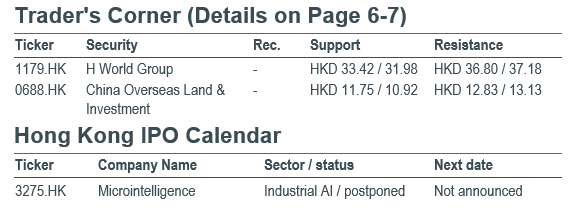
Traders' Corner
Our Technical View
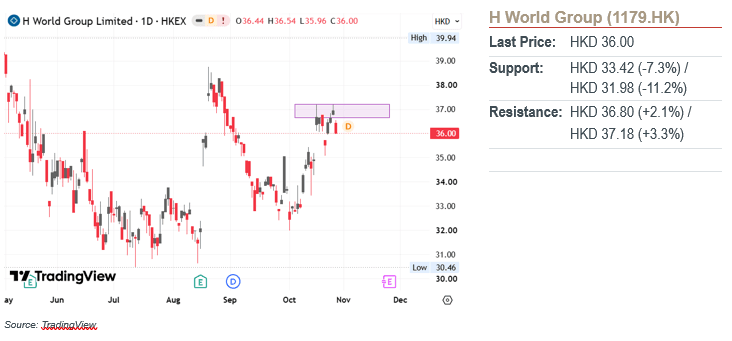
Price could have formed a swing-high peak at HK$37.18, with yesterday’s session executing a downside gap to form a structural Falling Window.
The RSI is turning downward from near overbought parameters with negative velocity.
As long as price remains capped beneath this gap ceiling, we see continued downward expansion toward lower support.
Our Technical View
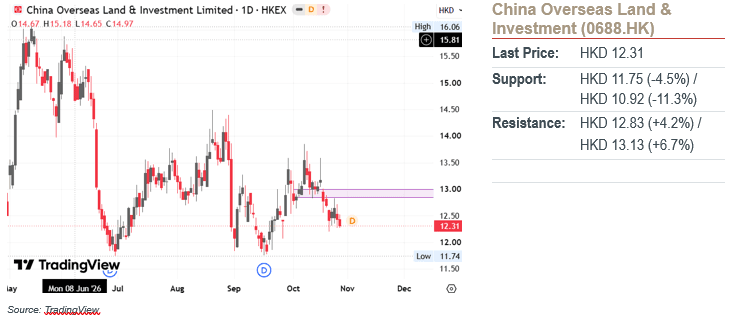
Price was capped by its support-turned-resistance zone, reinforcing a classic horizontal polarity flip.
The RSI is anchored in bearish territory and continues to slope downward with negative velocity.
As long as price remains suppressed beneath this converted resistance, we see continued downward expansion toward lower support.
Market Movers: At the 28 October close, the S&P 500 gained 0.28%. Oracle (ORCL US) rose 10.73% after targeting at least US$30bn of FY29 free cash flow. SK Hynix ADR (SKHY US) jumped 13.30% as 3Q operating profit rose 632% YoY to KRW83.3tn and planned 2026 shareholder returns reached approximately KRW100tn, including earlier buybacks. Genmab’s US ADRs (GMAB US) surged 28.25% after its Phase 3 petosemtamab combination halved death risk versus pembrolizumab alone in first-line PD-L1-positive advanced head-and-neck cancer; regulatory review remains ahead. After the U.S. close, Alphabet (GOOGL US) reported revenue up 25% to US$127.6bn but missed consensus, with a US$9.07bn free-cash-flow deficit. Microsoft (MSFT US) reported Azure revenue up 48% and US$18.6bn free cash flow, highlighting divergent AI cash returns. (Oracle / Reuters / SK hynix / Yonhap / Alphabet / Genmab / Microsoft / Reuters / Reuters) Alphabet (GOOGL US) is our Core Recommendation; Microsoft (MSFT US) and SK Hynix ADR (SKHY US) are our Investment Opportunities.
Macro: The Fed held rates at 3.75–4.00% in a 10–2 vote; both dissenters favoured a 25bp increase. The forthcoming ECB decision at 21:15 SGT is expected to leave the deposit rate at 2.50%. Watch inflation guidance and financial stress: a dovish shift could weaken the euro, while price pressures constrain easing. U.S. GDP and PCE data at 20:30 SGT test growth and inflation. (Federal Reserve / Bloomberg / ECB / Reuters poll / BEA)
FICC: December WTI settled at US$102.78/bbl, up 2.88%, while the U.S. 10-year Treasury par yield rose 6bps to 5.05%. Higher energy costs and long-term yields pressure financing conditions, keeping energy-sensitive margins and interest-rate exposure in focus. (Market data / U.S. Treasury)
AI
• Cash burn overshadows Alphabet’s cloud expansion. Alphabet (GOOGL US) reported after the close that revenue rose 25% YoY to US$127.6bn and Google Cloud grew 103% to US$30.7bn, but free cash flow was negative US$9.07bn. EPS fell to US$2.12 from US$2.87. Google also introduced Gemini 4 Carbon for phased access by cyber defenders. Strong demand therefore remains accompanied by substantial funding needs. (Alphabet / Google) Alphabet (GOOGL US) is our Core Recommendation.
• Memory demand turns into shareholder returns at SK Hynix. SK Hynix (SKHY US) reported revenue up 328% YoY to KRW104.6tn and operating profit up 632% to KRW83.3tn. The company plans about KRW100tn of 2026 shareholder returns, including previously announced repurchases. ADRs gained 13.30% to US$164.70. Contracts covering over half of 2027–28 capacity support demand visibility; Korea’s KOSPI rose 6.63%. (SK hynix / Yonhap / Market data) SK Hynix ADR (SKHY US) is our Investment Opportunity.
• Azure demand converts into cash for Microsoft. Microsoft (MSFT US) reported after the close that fiscal first-quarter revenue rose 19% YoY to US$92.3bn, Azure revenue increased 48% to US$33.2bn and adjusted EPS advanced 18% to US$4.89. Free cash flow reached US$18.6bn. Commercial remaining performance obligations rose 73% to US$677bn, supporting demand visibility, although delayed infrastructure deliveries helped spending fall below the company’s forecast. (Microsoft / Reuters) Microsoft (MSFT US) is our Investment Opportunities.
• Cash-generation timetable set by Oracle. Oracle (ORCL US) rose 10.73% to US$144.54 after management targeted positive free cash flow in the second half of FY28 and at least US$30bn in FY29. Additional capital raising through FY30 is capped at US$20bn, excluding refinancing. Expected lower capital spending supports the plan; execution and customer concentration remain central investment risks. (Oracle / Reuters / Market data)
Americas
• Next-generation diabetes case strengthens for Eli Lilly. Eli Lilly (LLY US) reported that in an 80-week Phase 3 comparison, investigational retatrutide 12mg reduced A1C by 2.2 percentage points and weight by 20.9%, versus 1.8 points and 9.4% for Ozempic 2mg. These are efficacy-estimand results assuming continued treatment. Adverse-event discontinuations were 7.9% versus 2.7%. The efficacy strengthens competitive potential, while approval and tolerability remain important. (Lilly / Reuters) Eli Lilly (LLY US) is our Core Recommendation.
• Grid-equipment reach expands for GE Vernova. GE Vernova (GEV US) agreed to acquire Trench Group for US$9bn, funded equally with cash and debt, with completion expected in late 2027 subject to approvals. Third-quarter orders rose 96% to US$29.3bn and backlog reached US$197bn. Shares fell 1.90% to US$878.03. The acquisition adds manufacturing capacity, while financing and integration require execution. (GE Vernova / Reuters / Market data) GE Vernova (GEV US) is our Core Recommendation.
• First earnings reaction stays subdued for Visa. Visa (V US) slipped 0.31% to US$400.60 in the first cash session after results. Fiscal fourth-quarter net revenue increased 13% YoY to US$12.1bn and adjusted EPS rose 17% to US$3.48. Cross-border volume excluding intra-Europe grew 14%. The quarterly dividend rises 16% to US$0.78; client incentives growing 21% highlight the cost of sustaining payments growth. (Visa / Market data)
• Record growth coupled with capital returns at Amphenol. Amphenol (APH US) rose 3.52% to US$80.96 after third-quarter sales increased 65% YoY to US$10.2bn, including 37% organic growth, and adjusted EPS climbed 74% to US$0.80. Orders reached US$12.2bn. A new US$4bn, three-year buyback begins in January; strong data-networking demand supports expansion, while acquisitions account for a meaningful share of reported growth. (Amphenol / Market data)
• Cash-session response turns positive for Seagate. Seagate Technology (STX US) gained 4.51% to US$697.97 in the first cash session after fiscal first-quarter results. Revenue rose 61% YoY to US$4.233bn and adjusted EPS reached US$7.68 versus US$2.61. The next-quarter revenue midpoint is US$4.8bn. Pricing and cloud storage demand support profitability, while capacity discipline and sustained customer orders remain key assumptions. (Seagate / Market data)
• Earnings outlook raised at Flex as infrastructure expands. Flex (FLEX US) rose 11.61% to US$93.03 after fiscal second-quarter sales increased 25% YoY to US$8.49bn and adjusted EPS rose 49% to US$1.18. FY27 adjusted EPS guidance rises to US$4.84–5.16 from US$4.42–4.74. Preparations continue for the Cloud and Power Infrastructure spin-off; current guidance includes the business and recent acquisitions, making separation execution an important consideration. (Flex / Market data)
• AI monetisation expectations lifted by ServiceNow. ServiceNow (NOW US) reported after the close that third-quarter subscription revenue rose 21% YoY to US$3.988bn and current remaining performance obligations increased 20.5% to US$13.65bn. Management raised its year-end AI annual contract value target to US$1.7bn from US$1bn at the year’s start. The full-year free-cash-flow margin target rises to 36%, reinforcing the focus on profitable enterprise adoption. (ServiceNow)
• Outlook reflects continued disruption at Boston Scientific. Boston Scientific (BSX US) fell 5.84% to US$42.43 after third-quarter sales rose just 1.5% YoY to US$5.138bn and adjusted EPS declined to US$0.73 from US$0.75. Management now forecasts full-year adjusted EPS of US$3.16–3.18 and fourth-quarter sales falling 1–3%. Recovery from its cybersecurity incident remains an operational priority, while the sales outlook limits near-term earnings visibility. (Boston Scientific / Market data)
• Strong cash generation directed towards returns at Phillips 66. Phillips 66 (PSX US) rose 1.95% to US$273.76 after the refiner reported third-quarter adjusted earnings of US$5.6bn, or US$14.08 per share, with 98% refining utilisation. It returned US$2.8bn to shareholders and reduced total debt by US$2bn to US$18.5bn. Strong refining economics support distributions, although exposure to volatile margins keeps the earnings base cyclical. (Phillips 66 / Market data)
• Slowing growth outlook overshadows F5 results. F5 (FFIV US) fell 20.43% to US$365.53 in the first cash session after results. Fiscal fourth-quarter revenue rose 13% YoY to US$917m, but FY27 revenue growth is guided to 8–9%, versus 11% in FY26. Adjusted EPS was US$4.42 versus US$4.39. A new US$1.5bn buyback authorisation provides support; slower growth expectations still weigh on the outlook. (F5 / Market data)
Greater China
• PetroChina benefits from stronger energy prices. PetroChina (0857.HK) reported Q3 attributable profit of RMB51.84bn, up 21.6% YoY on restated comparatives, after Hong Kong trading ended. Revenue increased 10.4% to RMB793.57bn. Nine-month refined-fuel sales fell 5.1% while operating cash flow rose 8.8% to RMB373.54bn. Stronger commodity earnings support cash generation, although weaker fuel volumes show domestic demand remains uneven. (Company / Egypt Oil & Gas) PetroChina (0857.HK) is our Core Recommendation.
• Ping An operating resilience contrasts with weaker headline earnings. Ping An (2318.HK) disclosed nine-month operating profit of RMB125.91bn, up 8.3% YoY, after Hong Kong’s close. Net profit fell 27.3% to RMB96.65bn and life-and-health new-business value declined 13.3% to RMB30.99bn. The property-and-casualty combined ratio improved 1.4 percentage points to 95.6%, supporting underwriting returns despite weaker investment-sensitive earnings and life sales. (Company / Rein Asia)
• Sands China extends maturities at higher borrowing costs. Sands China (1928.HK) priced US$1bn of senior notes: US$700m at 6.4% due 2032 and US$300m at 6.7% due 2033. Approximately US$989m of proceeds will help redeem US$700m of 2.3% notes due 2027, repay revolving debt and fund operations. The refinancing reduces near-term maturity pressure but replaces inexpensive debt with materially higher coupons. (Company / Asia Gaming Brief)
• China Overseas grows sales value despite lower contracted area. China Overseas Land & Investment (0688.HK) reported nine-month contracted sales of RMB181.04bn, up 6.2% YoY, despite a 19.2% decline in area sold to 6.12m square metres. Q3 revenue reached RMB32.8bn and operating profit RMB1.95bn. Its RMB49.22bn land purchases concentrate expansion in key cities, increasing exposure to stronger markets while requiring continued cash discipline. (Company / The Standard)
Asia ex. China
• Hitachi raises forecasts as infrastructure demand broadens. Hitachi (6501.T) lifted annual revenue guidance by ¥300bn to ¥12trn and net-profit guidance by ¥20bn to ¥920bn. Q2 revenue rose 15% YoY to ¥2.90trn, with all four operating sectors growing sales and profit. Energy and digital demand support the upgrade, although management continues monitoring higher interest rates and geopolitical effects on orders. (Company)
• Wilmar’s revenue growth masks pressure on processing margins. Wilmar International (F34.SI) reported Q3 core profit of US$267.3m, down 25.2% YoY, after Singapore trading ended, while revenue rose 13.6% to US$21.66bn. Higher raw-material costs and weaker soybean-crushing margins weighed on earnings. Excluding newly consolidated AWL, sales volume fell 2.7%, highlighting underlying demand pressure despite acquisition-driven headline growth and resilient palm-plantation operations. (Company / Business Times)
EMEA and Others
• Genmab’s pivotal cancer result drives a re-rating. Genmab’s US ADRs (GMAB) rose 28.25% to US$57.29 after its Phase 3 LiGeR-HN1 study met both primary endpoints. Petosemtamab plus pembrolizumab reduced death risk by 50% versus pembrolizumab alone in first-line, PD-L1-positive recurrent or metastatic head-and-neck cancer. No new safety signals emerged; regulatory engagement follows, while full data remain pending and approval is not assured. (Company / Market data)
• GSK’s specialty growth is offset by vaccine weakness. GSK (GSK.L) reported Q3 sales of £8.89bn, up 4% YoY at actual exchange rates, and core EPS of 54.6p versus 50.4p expected. Specialty-medicine sales grew 15% at constant currencies, but vaccines declined 2%. Guidance was maintained; vaccine weakness and looming HIV patent expiries keep pipeline execution central to sustaining growth beyond restructuring. (Company / Reuters)
• UBS accelerates distributions while capital rules remain unsettled. UBS (UBSG.SW) reported Q3 net profit of US$2.69bn, up 8% YoY, with US$55.1bn in wealth-management net new assets. It plans to finish its US$3bn buyback by February, earlier than mid-2027 previously envisaged. Higher client activity and integration savings support returns, but proposed Swiss capital requirements remain a constraint on the pace of future distributions. (Company / Reuters)
• Airbus retains targets despite a softer third quarter. Airbus (AIR.PA) reported Q3 adjusted EBIT of €1.77bn, down 9% YoY, and revenue of €17.47bn, down 2%. It retained targets of around 870 deliveries and €7.5bn adjusted EBIT this year. With 547 aircraft delivered through September, the remaining 323 underscore a demanding year-end production schedule and reliance on supplier execution. (Company)
• Equinor lifts output guidance as energy earnings strengthen. Equinor (EQNR.OL) reported Q3 adjusted operating income of US$12.35bn, approximately double a year earlier. Production rose 2% to 2.166m barrels of oil equivalent daily, prompting annual growth guidance of around 4%, versus 3% previously. Higher energy prices support cash generation, although management cautioned that production could ease from this year’s exceptional level in 2027. (Company / Reuters)
• Stellantis rallies as cost-saving confidence offsets cash burn. Stellantis (STLAP.PA) rose 15.39% after management said it could exceed €6bn of annual cost savings by 2028. Q3 adjusted operating profit increased to €256m from €90m a year earlier, while industrial free cash flow remained negative €4.01bn. The turnaround depends on targeted 2027 cash-flow recovery, with guidance retained despite persistent execution risk. (Company / Reuters / Market data)
Traders' Corner
Our Technical View
Price could have formed a swing-high peak at HK$37.18, with yesterday’s session executing a downside gap to form a structural Falling Window.
The RSI is turning downward from near overbought parameters with negative velocity.
As long as price remains capped beneath this gap ceiling, we see continued downward expansion toward lower support.
Our Technical View
Price was capped by its support-turned-resistance zone, reinforcing a classic horizontal polarity flip.
The RSI is anchored in bearish territory and continues to slope downward with negative velocity.
As long as price remains suppressed beneath this converted resistance, we see continued downward expansion toward lower support.
Disclosures and disclaimers
This report is provided subject to, and must be read together with, the full Disclosures / Disclaimers available at this link, which are incorporated by reference into this report. In particular, this report is intended for general circulation and informational purposes only and does not constitute personal investment advice or a recommendation to buy or sell any investment product or security. You should independently evaluate the information and, where necessary, seek advice from a qualified financial adviser regarding the suitability of any investment. Analyst certifications required under applicable regulations, including SEC Regulation AC (where relevant), are included in this report. By accessing, receiving or using this report, you acknowledge that you have read, understood and agreed to be bound by the Disclosures / Disclaimers, as may be amended, supplemented or updated from time to time.


